Why Professional Photos Sell Homes Faster

Table of Contents
How High-Quality Imagery Drives Buyer Engagement
The Psychology of Visual Decision-Making
Mobile-First Viewing Habits
Real Estate Photography Statistics: What the Data Shows
Why the Advantage Compounds
The Mobile-First Reality Behind the Numbers
What the Data Does Not Say
Professional vs. Amateur Photography: Key Differences
DSLR Cameras vs. Smartphone Photography
The ROI Calculation for Sellers
Step 1: Add Up Your Monthly Carrying Costs
Step 2: Convert to a Weekly Figure
Step 3: Compare Against the Photo Package
The Hidden Cost: Price Reductions
A Simple Rule of Thumb
How to Prepare a Home for Professional Photography
How to Book Professional Real Estate Photography Online
Frequently Asked Questions
Last Updated: September 19, 2026
How High-Quality Imagery Drives Buyer Engagement
Why do professional photos sell homes faster? Because the first showing almost always happens on a screen, not at the curb. Buyers decide whether to click, save, or scroll past in seconds, and listing photos carry that entire decision. At REimage Real Estate Media, we shoot and deliver listing media every day, and the pattern is consistent: strong imagery earns the click, and the click starts the showing.

The Psychology of Visual Decision-Making
Buyers process images before they process facts. A listing photo is judged in a fraction of a second, and that snap judgment shapes everything after it: whether the buyer reads the description, whether they request a tour, whether they remember the address at all.
Mobile-First Viewing Habits
Most buyers now scroll listings on a phone, often in short bursts between other tasks. That changes what a photo has to do. A wide-angle interior that reads clearly on a small screen beats a perfectly composed shot that turns to mush at thumbnail size.
Real Estate Photography Statistics: What the Data Shows
Most articles on this topic recycle a single aging figure, the often-cited claim that homes with professional photos sell about 32% faster, without noting that the underlying study dates to the early 2010s, before mobile listing apps dominated how buyers browse. That number is directionally useful, but it is not the whole story, and repeating it alone leaves sellers without the mechanism behind the speed advantage.
More views per listing. Listings with high-quality lead images consistently earn a higher click-through rate from search results than comparable listings with weak images. The lead photo does the work of a storefront window.
More saves and shares. Buyers who save a listing signal intent to the platform. Saved listings are re-surfaced to that buyer and often to similar buyers, extending reach without any additional marketing spend.
More showing requests. Saves convert to tours at a higher rate than passive views, which is where the time-on-market advantage actually originates.
Why the Advantage Compounds
Platform search algorithms rank listings partly on engagement signals, clicks, saves, and time on page. A strong photo set earns more of each, which pushes the listing higher in search results, which earns more engagement. A weak photo set does the reverse. Over the life of a listing, this loop widens the gap between a well-photographed home and a poorly-photographed one, which is why the speed difference is rarely a one-time bump.
The Mobile-First Reality Behind the Numbers
The majority of buyers now begin their search on a phone, often scrolling in short sessions. That matters for how statistics should be read. A photo that performs well on a desktop monitor can fail at thumbnail scale on a mobile screen, where brightness, straight verticals, and a single obvious focal point determine whether the buyer taps or scrolls.
What the Data Does Not Say
Be skeptical of any single percentage presented without context. Market, price band, season, and local inventory all move the numbers. What holds across markets is the direction: professional imagery correlates with more views, more saves, more showings, and shorter time on market. Treat the specific figures as directional and the mechanism as reliable.
Key Takeaway A single headline statistic is not the argument. The argument is the engagement loop: better photos earn more clicks, clicks earn more saves, saves earn more showings, and showings shorten time on market.
Professional vs. Amateur Photography: Key Differences
Professional real estate photography differs from amateur work in three places: light, geometry, and consistency. A professional controls all three on every shoot; a phone snapshot controls none of them reliably.
Light: Professionals balance interior and exterior exposure, often with HDR photography and supplemental lighting, so windows show a view instead of a white blowout.
Geometry: A wide-angle lens and a leveled tripod keep vertical lines straight. Tilted walls read as sloppy, even to buyers who cannot say why.
Consistency: Every room is shot to the same standard, so the listing feels like one property instead of a random camera roll.
DSLR Cameras vs. Smartphone Photography
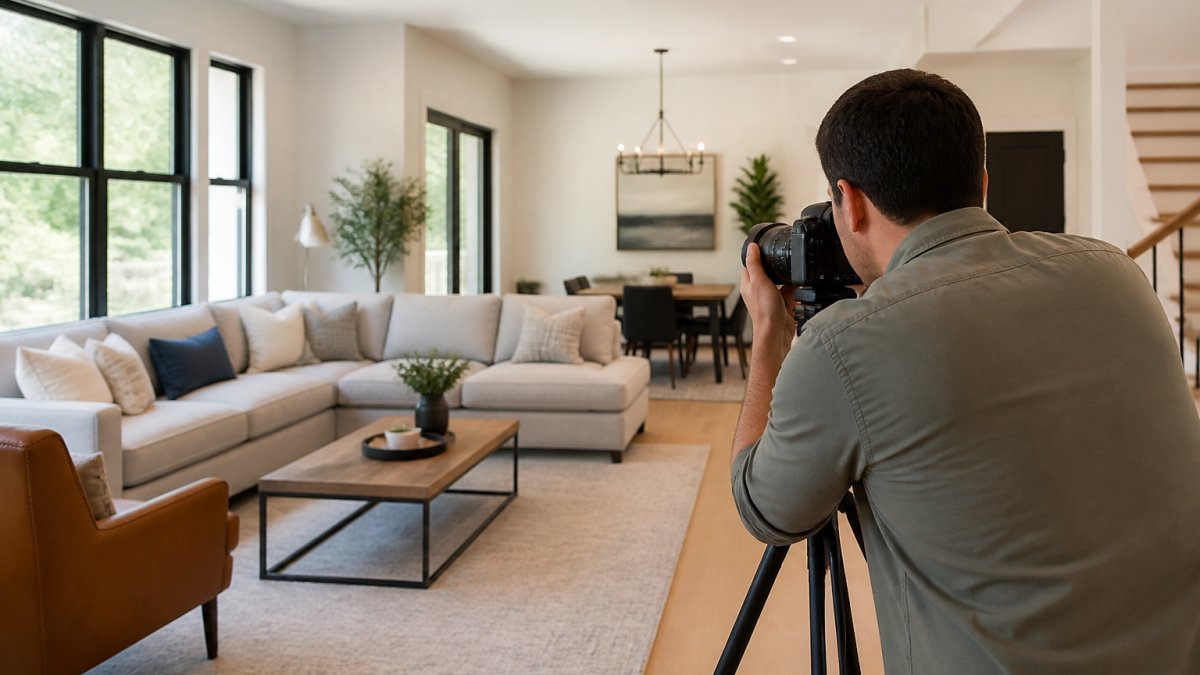
Modern smartphones take impressive photos in good light, and for a quick rental refresh, they can be adequate. Where they fall short is control: sensor size, lens choice, dynamic range, and manual exposure all favor a DSLR camera or mirrorless body on a tripod.
Factor | Professional Photography | Smartphone Photography |
Lighting control | Full, with strobes and HDR | Ambient only |
Lens range | Wide-angle to detail | Fixed, digital zoom |
Vertical correction | Leveled in camera and edit | Rarely corrected |
Consistency across rooms | Standardized | Varies shot to shot |
Best for | Primary listings, high-value homes | Quick updates, rentals |
The ROI Calculation for Sellers
The return on professional photos is easiest to see in the cost of waiting. Every extra week on market carries holding costs, and those costs usually dwarf the price of the photo package. Here is how to calculate it for your own listing.
Step 1: Add Up Your Monthly Carrying Costs
List every recurring cost you pay while the home is unsold:
Mortgage interest (principal is not a cost here, it is equity you keep)
Property taxes
Homeowners insurance
Utilities (electric, gas, water, trash)
Lawn care, snow removal, or HOA dues
Maintenance and any staging rental fees
Add those together for a monthly total.
Step 2: Convert to a Weekly Figure
Divide the monthly total by roughly 4.3 to get a weekly carrying cost. That number is what each additional week on market actually costs you out of pocket.
Step 3: Compare Against the Photo Package
A professional real estate photography package is typically a one-time expense. If better imagery shortens the selling cycle by even a few weeks, the savings in carrying costs usually exceed the cost of the shoot, often by a wide margin. That is the entire ROI calculation, and it is why agents who track it rarely return to amateur photos.
The Hidden Cost: Price Reductions
Carrying costs are only part of the picture. Homes that sit tend to attract lowball offers, because buyers assume something is wrong with a listing that has been on the market for weeks. A price reduction to reignite interest often costs more than the entire marketing budget, including photography. The photo package is the cheapest line item in the plan and the one most likely to prevent the reduction in the first place.
A Simple Rule of Thumb
If your weekly carrying cost multiplied by the number of weeks you expect professional photos to save exceeds the cost of the shoot, the photos pay for themselves. For most listings, that threshold is crossed quickly.
Key Takeaway The strongest argument for professional photos is not aesthetics. It is the carrying cost of every extra week a listing sits, plus the price reduction that often follows, both of which typically dwarf the price of the shoot itself.
How to Prepare a Home for Professional Photography
Preparing a home for professional photography is mostly about removing distractions so the space reads clearly. You do not need to renovate; you need to declutter, clean, and stage lightly.
Clear countertops, nightstands, and bathroom vanities of personal items
Remove magnets, notes, and photos from the refrigerator
Open blinds and turn on every lamp for balanced light
Replace burned-out bulbs and match color temperature room to room
Tuck away trash cans, pet bowls, and charging cables
Straighten bedding, fluff pillows, and smooth sofa cushions
Park vehicles away from the driveway and front curb
Mow, edge, and clear the entry of shoes, mats, and toys
Pro Tip Schedule the shoot for late morning or early afternoon when natural light is strongest, and ask the photographer which rooms need the most attention. A two-minute conversation before the shoot usually saves a reshoot later.
How to Book Professional Real Estate Photography Online
Booking professional real estate photography online takes minutes when the provider runs a real scheduling system. Look for a service that shows availability in real time, confirms the appointment automatically, and delivers edited images on a predictable timeline.
Watch Out Do not book a shoot before the home is photo-ready. Rescheduling costs you a slot, and shooting a cluttered home wastes the session and the fee.
Frequently Asked Questions
How much faster do homes with professional photos sell?
Homes with professional photos tend to sell faster because they attract more clicks and showings from the start. While the exact number of days saved varies by market and price point, the pattern is consistent: listings with high-quality imagery get more views, more saves, and more showing requests than those with amateur photos. The result is a shorter selling cycle and less time carrying the costs of an unsold property.
Is professional real estate photography worth the investment?
For most sellers, yes. The cost of professional photos is a small fraction of the total sale price, and the return shows up in two ways: faster sales that reduce carrying costs, and stronger offers that come from buyers who feel confident about the property before they ever step inside. When you factor in mortgage payments, taxes, and insurance for each additional month on the market, the math usually favors professional imagery.
What are common mistakes to avoid in real estate listing photos?
The most damaging mistakes are dark or blurry images, cluttered rooms, poor angles that make spaces look smaller, and photos taken on cloudy days without proper lighting. Other frequent issues include toilet lids left up, personal items visible in frames, and exterior shots that hide the home's best features. Professional photographers avoid these problems by using wide-angle lenses, HDR photography, and proper lighting techniques.
How does high-quality imagery influence online buyer behavior?
Buyers scrolling through listings make split-second decisions about which homes to click. High-quality imagery stops the scroll, increases click-through rates, and keeps buyers on the listing longer. On mobile devices, where most searches happen, clear and bright photos are even more important because small screens make poor images look worse. Better photos lead to more saves, more shares, and more showing requests.
Real estate moves fast, and a listing that sits loses leverage with every passing week. Professional photos are the cheapest way to shorten that window, and REimage Real Estate Media makes them easy to get: 24/7 online booking, next-day delivery, a free basic 2D floor plan with every order, plus drone photography and virtual staging when the property calls for it. Book your shoot with REimage Real Estate Media and put your listing in front of buyers at its best.
BOOK NOW

Comments